


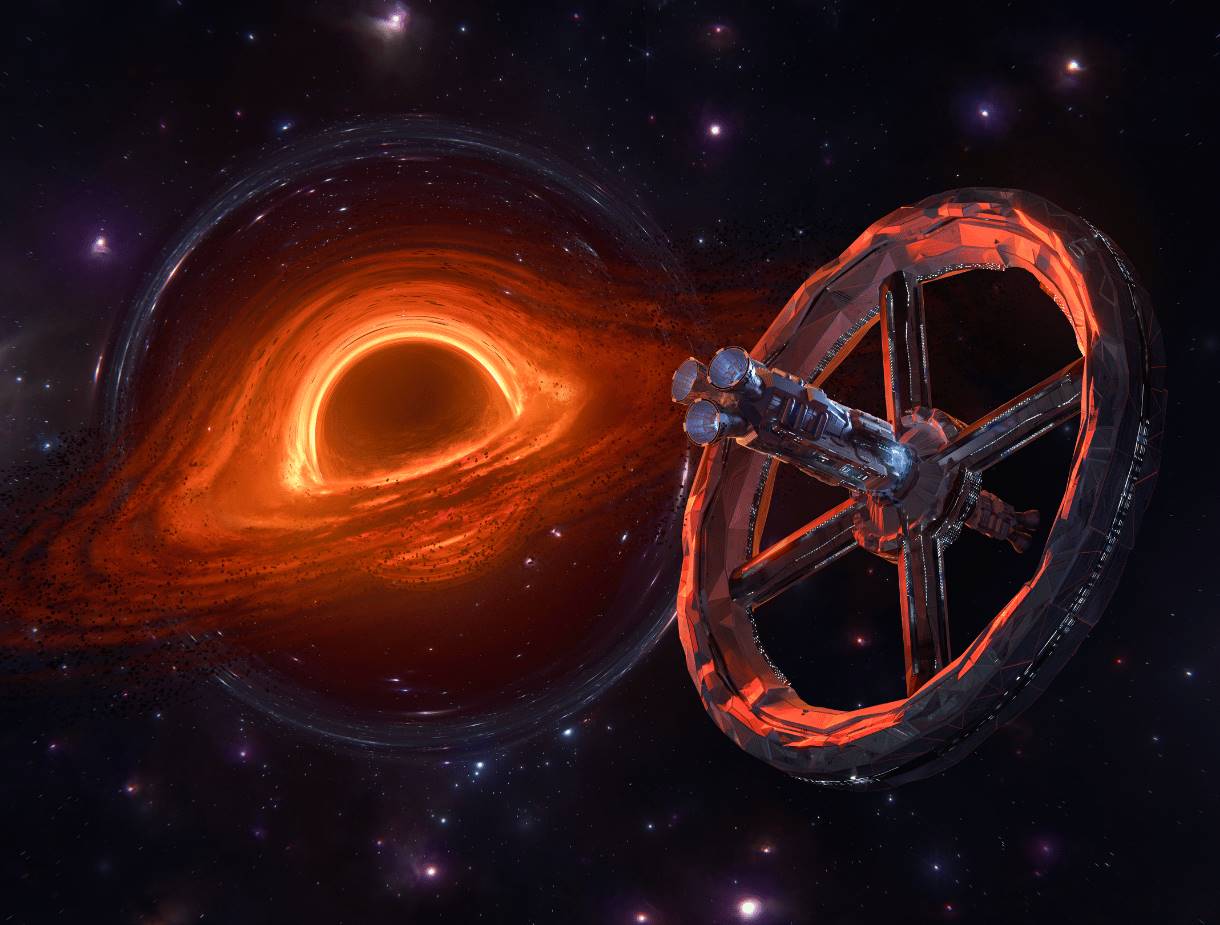
The Hole-Man is gritty dystopian military science fiction with a beating heart…and deep storybuilding.
Come with me on a mission behind the creative curtain…or should I call it the event horizon (beyond which no secrets escape)? 😏
Until now!
The Concept
I lived in Mexico for two years as a child. Our family traveled all over, visiting many ruins of the Aztecs and Mayas. At the Mayan site known as Chichén Itzá, one particular feature fascinated me (in a dark sort of way).
It was the sacred cenote: a huge hole in the ground filled with water…and previously fed with the bodies of sacrificial victims. I imagined the last moments of these innocents, many of whom were children. The disturbing memory never let go.

Many years later, that experience leapt to mind, but with a sci-fi twist.
What if the cenote was instead a black hole? What if a future civilization had been taught that human sacrifices to the hole were necessary to appease the gods?
And—most importantly—what would it be like to be the executioner? How would he cope with killing innocent victims? What would it cost him…and his family? What would keep him from just throwing himself into the hole? Was there any path to break free and redeem himself?
Thus, the premise of The Hole-Man was born.
The Characters
Despite this “high concept” (a polite way of saying a wild and weird idea), I was determined to make this a very human story. It would be all about the characters. About their wounds and wrestling. About grief and growth. Relationships. Betrayals. Love and grace.

The Hole-Man (aka Baard Larsen) came to mind first, of course. He’s a flawed man, one with cracks in his armor he tries to patch up. He has the worst job in the universe, he’s lost his wife and abandoned his daughter, and the guilt takes its toll. But I knew he still needed a push to put him over the edge…and onto his ultimately heroic path. Because Baard embodies this question: Are we forever defined by our darkest sins?

In comes Maizia: the next sacrifice. Her entrance on stage, full of wit and theatrics, was a wonderful discovery as an author. Yes, a discovery. I knew some basic things about her character as I started writing, but most of Maizia’s intriguing layers revealed themselves as I wrote. Certain hidden physical features, her heritage, her relationship with Baard’s daughter—these all jumped onto the page as the story came together. And her character arc kept on tugging in complex directions, as if Maizia refused to be chained down by her author! Her challenging emotional and spiritual journey wasn’t manufactured—it flowed from her very depths.

The daughter, Alana, is another independent spirit. Because Maizia has been her mentor for many years, she shares many of her characteristics (like a child might take after a parent). Yet I had to create sufficient distinction between them. Alana deserved her own narrative voice. It’s a younger voice, one so intent to prove herself that she makes rash decisions. But she also entrusts herself to friends, something neither Baard nor Maizia are good at. Also, behind Alana’s stubbornness lies a sensitive soul. She values life—even lives of the enemy. Which makes accepting her executioner father that much more difficult.

The Prismatics and the Triad
One of my tenets as a sci-fi author is that God is in the story universe. Sometimes deep in the background, other times working through the characters and their circumstances. But never as an “easy out” to story problems. After all, does God swoop in and solve all of our life’s issues?
Also, a story isn’t a sermon. So integrating faith into The Hole-Man was absolutely not about preaching. It was simply reflecting a likely feature of any interstellar colony: religion as an inherent part of human culture.
Not all religions are created equal. They often clash, whether in theology debates or on battlefields. And, in many cases, religion is misused to manipulate and grasp power.
Enter the Prismatics, the polytheistic ruling class. Their dogma (whether they actually believe it or not) feigns “tolerance” yet has been used to justify the Hole-Man’s grim duty. The story’s chief antagonist, the Inquisitor, is their head. And what a sick head! Writing scenes with the Inquisitor made me want to wash my hands afterward. The divine is the last thing on his mind. And he doesn’t want any true divinity to emerge from the shadows.

The notion of the Triad came from Christian theology (the Trinity). But this civilization, over just a few generations, had lost its anchor point. Few knew what the Triad was; even its followers had only rudimentary understanding of “the God-in-triplicate.” It might have seemed a “smaller” polytheism to some (despite its monotheistic foundations). Without Scripture to inform them, deeper knowledge was impossible.
Yet, to use a biblical term, a remnant of the faith has survived. And its power isn’t displayed in political might or miracles. Like an insistent breeze, its presence weaves through the characters and the world they inhabit.
And there’s so much of that world yet to explore!
Stay tuned for Part Two, where I’ll dive deeper into the worldbuilding of The Hole-Man.
Until next time!
Dan