

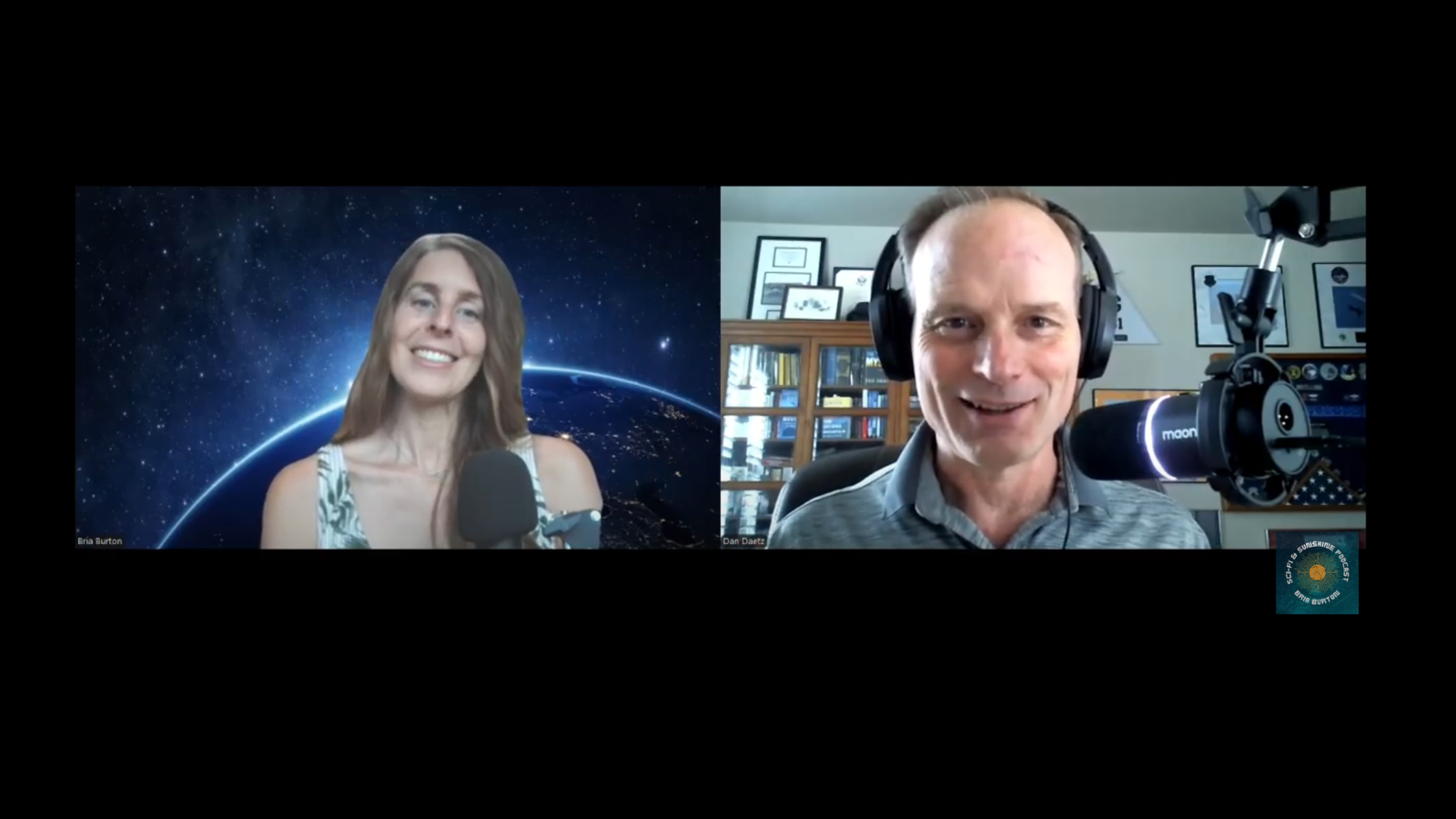
This is an interview excerpt from my appearance on Sci-Fi & Sunshine podcast with Bria Burton.
Bria Burton: This is Bria at the Sci-Fi and Sunshine podcast. I’m a running mom and a speculative fiction author here with Dan Daetz. I am so excited to introduce you all to sci-fi author Dan. And I’m going to hand it over to you, Dan, to introduce yourself.
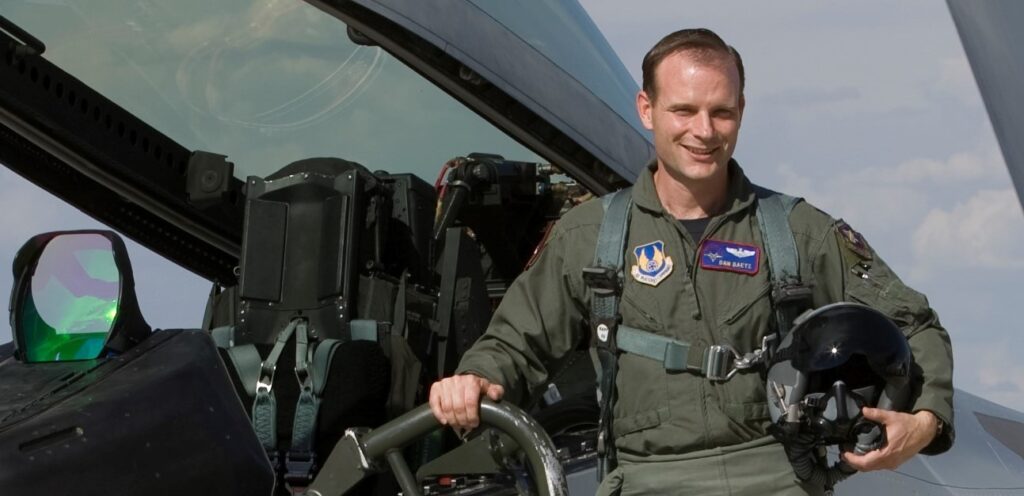
Dan: I like to describe myself as a test pilot with a writing problem.
Bria: Oh, I love that.
Dan: My background was over 20 years serving in the Air Force. Great time, great friendships and flying lots of different things. But I’ve also always been a fan of especially sci-fi, but other spec fiction as well. And so I really just started to get inspired to get into the writing side of it.
Bria: I kind of think of you as a twin brother because when I first met you, we were lined up for the costume night [at the Realm Makers conference]. I was Princess Leia from A New Hope. You were X-wing fighter pilot Luke from A New Hope. And it was just, oh, hey, we’re buddies. like nice to meet you. It was so awesome!
Dan: It was so fun. [This year] I was Obi-Wan…or as I described myself, I was a failed youth pastor for Jedi… It didn’t work out so well, right?
I’m just going to give props to my wife wife because she is not a cosplayer, nor is she a fiction reader, but she is an excellent seamstress and she actually helped put together my whole Obi-Wan costume. She did the whole thing from scratch with the exception of the boots and the belt. I’ve got I’ve got a very supportive team here at home that allows me to play.
The conference was superb. Such a mutually supportive environment. All ages…and across the whole spec fiction universe. I got to be tutored by some excellent sci-fi writers in the Christian sphere: Kathy Tyers, Ronie Kendig. They’ve written space opera. Firebird for Kathy Tyers is well known. Ronie Kendig has a series I can never pronounce—The Droseran Saga—and Brand of Light is the first book.
Bria: Let’s move into when we first met. We were talking about this debut sci-fi novel that’s coming out. You had a short story that was essentially a lead-in. Talk a little bit about that short story. It was such a fun read!
Dan: It’s a play on words like authors like to do… It’s called The Storm of the Eye, and it’s about a pilot on his birthday. He thinks he’s going to be on leave, but he gets called into combat against these rebels who live in the shadowy canyonlands. It’s his 25th birthday.
So he goes out—and I won’t spoil too much of the story, except to say there’s a lot of flying action and there’s a twist at the end. It really gives you insight into the young man who will then become the older guy in the full-blown novel. I really wanted to explore how did this guy start to think the way that he did—that might have led him into the role he plays in the full-blown book.
Bria: So when you started writing this short story, was it, oh, I’m just going to write a short story and then wait a minute, there might be more? Or was it the reverse? Okay, I’ve got this novel. I want a I want a short story to introduce this guy. Which came first, the chicken or the egg?
Dan: The novel was drafted. Now, for all of us who write these things, it takes a while to go from first draft to polished. But in between that process, I was like, I want to explore this guy’s origin story a little bit deeper. And rather than put all that backstory in a book, why don’t we do an event? A little snapshot through a short story.
Bria: So the novel is coming out. It’s called The Hole-Man. You have a version for Kickstarter where they’re getting color illustrations. Who did those?
Dan: I didn’t want to have AI illustrations. I don’t use AI for writing—other than like research and stuff like that. I reached out through either freelancers or people I know.
Emilie Haney is my cover designer and she’s awesome! She’s also helping me with bookmarks. For the other illustrations, I reached out to other freelancers with a vision of what I wanted.
I’m getting maps. Maps are fun. As a pilot, I had to have a picture of the airplane [from the book]. They’re not super high technology level. It’s like humanity has gone to a new place and decided all that technology was maybe not the best thing for us. Nobody walks around with cell phones. Almost like 20th century but in this futuristic world—a dichotomy.
If you’re familiar with Dune, it takes place in this grand universe yet their technology is a simplified version of tech.
Bria: Before we switch over from the Kickstarter, how did you find that whole process?
Dan: One of the first things I did is I reached out to a few people I know and said, “Would you just please pray over this project?” I’m a praying person. I have some very gracious people who have been supporting in this way.
I don’t think it’s just about how much money a Kickstarter raises. It’s also an opportunity to build community. People feel like they’re part of something, not just consuming.
Bria: Let’s get into the book itself. It’s what I would call a rip-roaring rocket ride. It’s full of heart and it’s full of adrenaline.
Man, it is intense. It’s so fun. Then there’s some of the character dynamics. A lot of conflict that is so relatable. Father-daughter. Baard and Alana, his daughter, are going from one crisis to the next.
Tell us the broad overview or some key points about the novel. It’s called The Hole-Man. Tell us why that title.
Dan: The premise is fairly dark although the story doesn’t stay dark. A guy who’s got the ugliest job in the universe because his job is to feed human sacrifices into a black hole.
Just think about the perspective of an executioner who has that kind of job. His thought process. If I do this job, it’ll clear my slate—because he’s got some backstory—and then I’ll be able to reunite with my family. It’s like a bargain with the devil.
That [job] caused him to be away from his family for years—particularly his daughter. It’s a story about reunion and about redemption, some very core things that we crave as people.
The worst things that we’ve done in life—do we want them to define us? Or do we want to have another chance to write a different story? That’s the core message.
Also the fraught reunion thing. Having been a military guy, you go away and you come back. There’s always a period of adjustment for families. How do we rebuild after that separation, and a lot of ugly things that have happened along the way.
Bria: I’ll bring up the bigger greater world context. This is not Earth. The setting is this other planet. What I actually appreciate is there’s not a lot of explanation. There’s like little tidbits that are dropped in very effectively to explain without info dumping that humanity ended up having to evacuate Earth because of problems. I like that you leave a little bit to the imagination. And so they find this other planet, but there’s a black hole in the backyard.
There is a lot of combat, even one-on-one. And the dog fights are really fun with the fighter jets. I got the sense as I was reading that this was PG-13, if you will.
Dan: My intent when I started was to write stories that my daughter—who was then about 13 and 14—could read. That was my inspiration to start writing. I had that in the back of my mind in terms of what my boundaries were as a writer.
Bria: What was your favorite part to write?
Dan: That’s like picking your favorite child…
The beginning—introducing the characters and the stakes—was fun because I’m discovering these characters along the way. I had an idea about who they were, but the fun part is discovering who they are and really finding their own voice—because this book is written in three different voices.
I was very intentional that there would be no “slow middle” [of the book]. So a lot of the action—the flying action and things that are pretty intense—is in the middle of the book.
But if I had to point somewhere, I would say writing the end of the book—including the very last sentence—was my favorite. It brought to the surface all the things that have been boiling and these themes of Who am I now? I used to be that kind of person, but now I can be a different kind of person. How does that show up in my relationships…what choices do I make…where does God fit in, or is there even such a thing?
A lot of things get tied up at the end. And while this story is planned to continue, it does have enough closure to make it complete, not a cliffhanger.
Bria: Definitely there’s great closure at the end. And that was just really fun to discover actually how that ending was going to turn out.
How would you say faith played a role for you in writing this novel?
Dan: I’m not one who wants to make this some sort of a Bible lesson or anything like that. I just have this premise that God is in the universe. Whether God is on the stage or he’s sort of offstage, that at least he exists.
When I grew up reading some classic sci-fi, he wasn’t even part of the picture or he was put into some other not very helpful language about God. So in this story there is God peeking up. But it’s not like God in the story makes everything turn out right.
There’s that element and I just want it to be organic—not because I’ve got a lesson to pound home. It just fit the characters’ journeys, because this is a world where faith isn’t totally non-existent. It’s just been buried by history for a while. There’s always been a remnant of it, but it’s starting to get rediscovered in light of this horrible regime that would even do such a thing as send out somebody to throw human sacrifices into a black hole.
Bria: And you do have quite the villain, I will say. And there there’s more than one. There is a mole. I’m not going to spoil anything, but it’s this story that just has it all. I enjoyed it so much!
Final question. When you’re writing these dog-fighting scenes…the action is so well done in this book. I know you obviously have experience. How did that experience tie into writing?
Dan: The one thing I did not want to do was to overwhelm the reader with jargon and things. You use the jargon to breathe life into the story, not to confuse the reader.
I have sketches of how the dog fights go. And I literally had a little note [to myself]: How to make this simple? Because the actual job of being a fighter pilot has a lot of complexity.
Also, it’s really about the characters. One of the unique elements is a father and daughter going into combat together. How would I feel as a dad if I brought my daughter into combat?
Bria: And there’s a wonderful tension with that. It’s so well done here.
Thank you, Dan, for coming on to the Sci-Fi and Sunshine podcast. I cannot wait to get your book in print. I had the honor of reading the [ebook] version ahead of this podcast, but I’m very excited to actually hold it in my hand!
Dan: Thanks so much, Bria. It’s been a pleasure!
[Excerpted/adapted from the Sci-Fi and Sunshine podcast by Bria Burton, Episode 21]